CPA, Fractional Controller, or Fractional CFO: Where Should Growing Businesses Get Accounting Help?
A business owner reached out to me and said something many growing companies eventually feel.
They liked their CPA.
The work was getting done.
But they still felt like something was missing.
The issue was not that the CPA was doing a bad job. The issue was that the business needed a different kind of financial support.
They already had help with tax and compliance. What they wanted was more guidance around cash flow, profitability, reporting, and where they should focus their efforts to grow.
That is a common place for founders and executives to get stuck.
They know they need better financial support, but they are not always sure who they actually need: a CPA, a bookkeeper, a fractional controller, or a fractional CFO.
The answer depends on the problem the business is trying to solve.
Your CPA May Not Be the Problem
A CPA often plays an important role in a business.
For many companies, the CPA helps with tax filings, tax planning, compliance, financial statement preparation, and other reporting needs. In some cases, a CPA may also provide audit, review, or compilation services.
That work matters.
A business needs to stay compliant. It needs clean tax reporting. It needs someone who understands the rules and can help keep the business protected.
But that does not always mean the CPA is the right person to manage the company’s internal financial process or provide ongoing decision-support analysis.
It is a difference in role.
The Questions Are Different
Compliance-focused accounting is often centered around answering questions like:
· Was this recorded correctly?
· Are the financial statements prepared properly?
· Are tax filings complete?
· Is the business meeting its required obligations?
Those are important questions.
But they are not the only financial questions a growing business needs answered.
The Missing Layer Is Often Controller-Level Support
Many businesses do not have a tax problem. They have a financial visibility problem.
The financial statements may exist, but they may not be timely, useful, or detailed enough to support better decisions.
This is where controller-level support becomes valuable.
An outsourced or fractional controller is typically focused on the internal accounting function and the quality of financial reporting used by management.
What a Controller Helps Manage
Controller-level support can include:
· Month-end close management
· Account reconciliations
· Accruals and adjusting entries
· Financial statement analysis
· Budgeting and forecasting
· Cash flow management
· KPI tracking
· Trend analysis
· Variance analysis
· Management reporting
· Process improvement
A controller is not just looking at whether the numbers were recorded. The controller is looking at whether the numbers can be used.
That distinction matters.
Turning Records into Useful Insight
A business owner does not just need to know what happened last month. They need to understand what the numbers are saying and how to use that information.
Revenue may be growing, but cash may feel tight.
The business may be profitable on paper, but the owner may not know which customers, services, products, or locations are actually driving the results.
Expenses may be increasing, but leadership may not know whether those costs are supporting growth or simply creating drag.
A controller is focused on helping the business understand what is happening inside the numbers.
Better Reporting Should Help Answer Better Questions
That could mean asking:
· Which services or customers are most profitable?
· Where is margin improving or declining?
· Why is profit not turning into cash?
· Which KPIs should management actually monitor?
· Where is the business creating operational complexity?
· What trends are developing before they become bigger problems?
· Where should the business invest further?
· What needs to change before growth creates more strain?
Those are not just accounting questions. They are business questions supported by accounting.
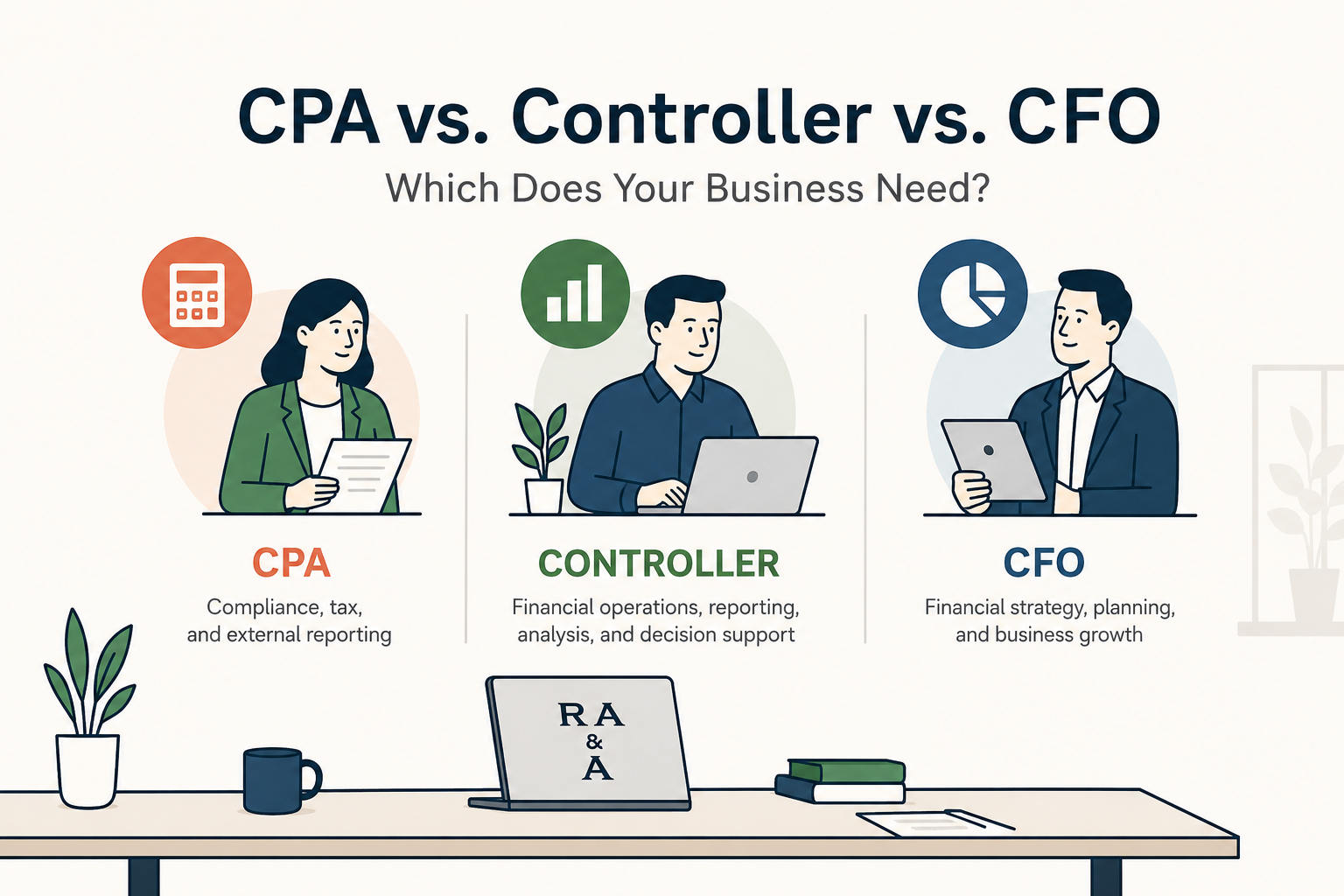
CPA, Controller, or CFO: A Practical Way to Think About It
CPA: Compliance, Tax, and External Reporting
A CPA often helps with compliance, tax, and external reporting needs.
If the business needs tax filings, tax planning, or assurance-related services, a CPA may be the right resource.
Controller: Financial Operations, Reporting, and Decision Support
A controller helps manage the accounting function, improve reporting, close the books, analyze financial results, monitor KPIs, support budgeting and forecasting, and create better cash flow visibility.
If the business needs more reliable monthly financials, better reporting, KPI tracking, budgeting, forecasting, and cash flow management, controller-level support may be the missing piece.
CFO: Higher-Level Financial Strategy
A CFO helps with higher-level financial strategy, financing, capital allocation, investor support, banking relationships, acquisition planning, and major business decisions.
If the business needs capital strategy, investor support, acquisition planning, or high-level financial leadership, a CFO may be appropriate.
The Bottom Line
The Right Support Depends on the Problem
If your CPA is doing good work but you still feel like something is missing, the problem may not be your CPA.
The business may simply need an additional layer of financial support.
Better decisions require more than accurate historical records. They require timely reporting, financial analysis, KPI visibility, budgeting, forecasting, and cash flow management.
For many growing businesses, controller-level support is the bridge between basic accounting and higher-level financial strategy.
The better you understand the difference, the easier it becomes to get the right kind of financial support at the right time.
Ready to Strengthen Your Financial Reporting?
Whether you're experiencing reporting challenges, cash flow uncertainty, or growing complexity, fractional controller support can help establish the structure and visibility needed to support better decisions.