Why Your Business Budget Should Start with Sales, Not Expenses
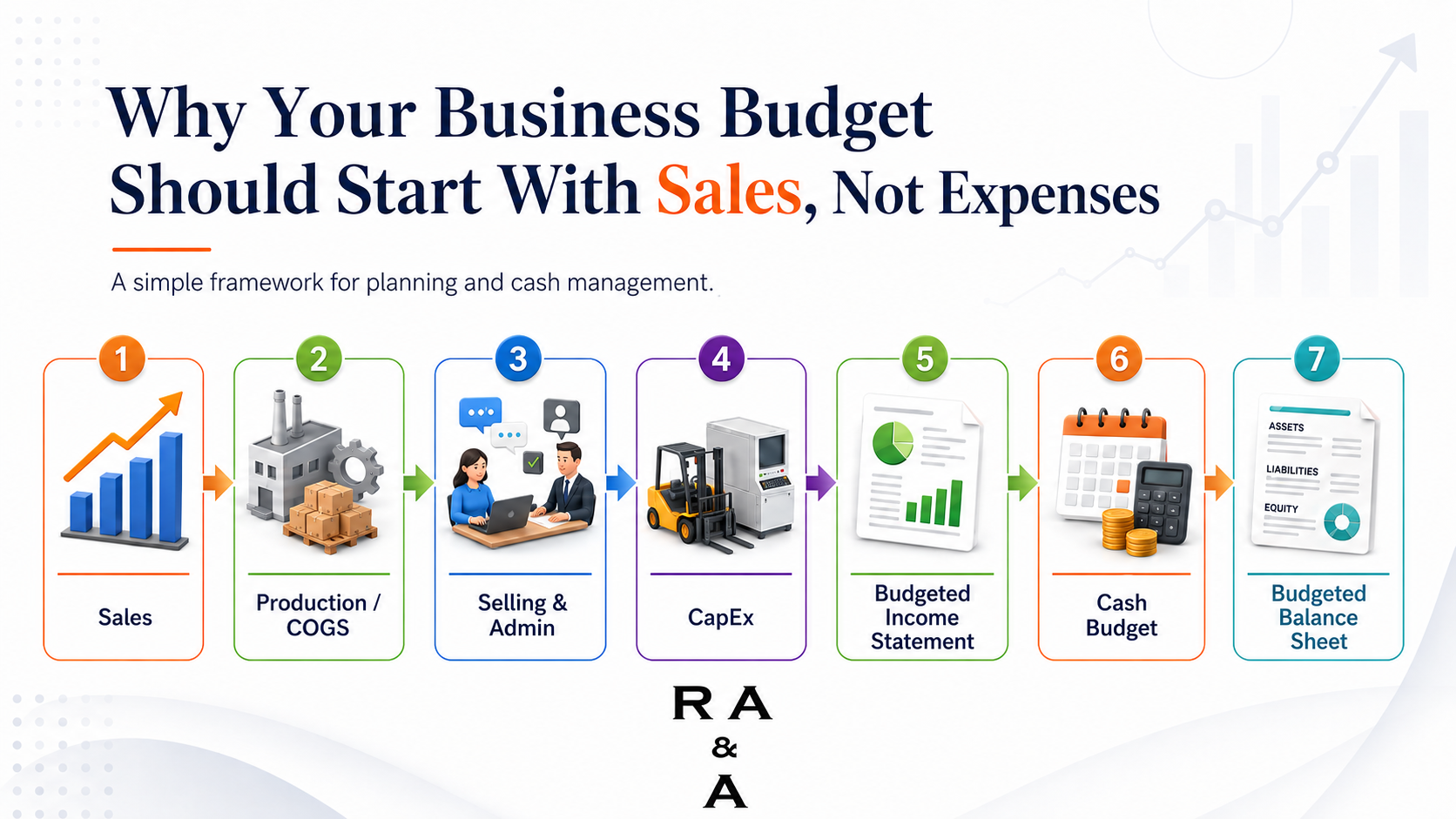
Quick answer: A business budget usually starts with sales, then moves to production/COGS, selling and administrative costs, capital expenditures, the budgeted income statement, cash budget, and budgeted balance sheet.
Your books may be in order.
Knowing where the business has been may not be the problem.
The bigger challenge is knowing how to use that information to plan what comes next.
Accounting should not stop at reporting what already happened. Done well, it becomes the foundation for budgeting, forecasting, cash planning, and better business decisions.
A business budget is not just a spending plan. It is a financial model for how the business expects to operate and manage cash.
That is why the order matters.
Many businesses start budgeting by listing expenses. Payroll, software, rent, marketing, insurance, and other costs all get entered first. Those items matter, but starting there can create a disconnected plan.
A stronger budget usually starts with sales.
Start With the Sales Budget
The sales budget is the foundation of the plan.
Before a business can properly plan costs, staffing, inventory, cash flow, or future investment, it needs to estimate expected revenue.
That means looking at things like:
Revenue assumptions
Pricing
Expected unit sales
Customer demand
Seasonality
Growth expectations
This does not mean the sales forecast will be perfect. It will not be. But without a reasonable sales estimate, the rest of the budget is mostly guesswork.
Sales drives the activity of the business. The rest of the budget should be built around that expected activity.
Plan Production and Cost of Goods Sold
Once expected sales are estimated, the next question is simple:
What resources are needed to support those sales?
For a product-based business, this may include materials, inventory, labor, production costs, and overhead.
For a service-based business, this may include staffing capacity, contractor support, software, delivery costs, and other costs tied to serving customers.
This part of the budget connects revenue expectations to the cost of delivering the product or service.
It helps answer questions like:
Do we have enough capacity to support the sales plan?
Will we need more labor, materials, or inventory?
Are costs increasing as revenue grows?
Are margins expected to improve, decline, or stay the same?
This is where budgeting becomes more than an expense list. It starts becoming an operating plan.
Add Selling and Administrative Costs
After planning the costs directly tied to sales and operations, the business can plan selling and administrative costs.
These are the costs needed to run and support the business, such as:
Payroll
Marketing
Customer service
Administrative support
Software
Professional services
Other overhead departments
These costs may not always move directly with sales, but they still need to support the overall plan.
For example, a business expecting significant growth may need additional customer service, sales support, accounting support, or management capacity.
The key question is not just, “What did we spend last year?”
The better question is, “What will the business need in order to support the plan for next year?”
Include Capital Expenditures
Capital expenditures are larger investments in the business.
These may include:
Equipment
Vehicles
Computer hardware
Systems
Major projects
These items matter because they affect more than one part of the financial plan.
They can affect cash needs, debt or financing requirements, depreciation, operating capacity, and the projected balance sheet.
A business may look profitable on paper but still run into cash pressure if major investments are not planned properly.
That is why capital expenditures should not be treated as an afterthought.
Build the Budgeted Income Statement
Once sales, cost of goods sold, selling and administrative costs, and capital expenditures are considered, the business can build a budgeted income statement.
This shows how the business is expected to perform.
It brings together:
Revenue
Cost of goods sold
Gross profit
Operating expenses
Expected profit or loss
This is often the part business owners are most familiar with because it looks like the profit and loss statement they already review.
But the budgeted income statement is only useful if the assumptions behind it make sense.
Sales drive the top line. Production, delivery, and operating costs follow. The income statement should reflect the operating plan, not just last year’s numbers copied forward with a percentage increase.
Build the Cash Budget
Profit and cash are not the same thing.
A business can be profitable and still have cash flow problems.
That is why the cash budget is an important part of the budgeting process.
The cash budget helps answer:
Will the business actually be able to pay for the plan?
It considers items such as:
Timing of customer collections
Timing of vendor payments
Payroll timing
Seasonality
Capital expenditures
Loan payments
Financing needs
This is especially important for growing businesses.
Growth often requires cash before the benefit fully shows up in the bank account. Inventory, payroll, contractors, equipment, and other costs may need to be paid before customers pay their invoices.
A cash budget helps identify those timing gaps before they become problems.
Prepare the Budgeted Balance Sheet
The budgeted balance sheet shows the financial position the business is expected to be in after the plan is carried out.
It brings together the impact on:
Assets
Liabilities
Equity
This includes expected cash, receivables, inventory, fixed assets, debt, payables, retained earnings, and other balance sheet accounts.
The balance sheet is where the plan starts to show its full financial impact.
A budgeted income statement may show expected profit. The cash budget may show whether the business can fund the plan. The balance sheet helps show where the business is expected to stand financially at the end of the period.
Why the Order Matters
Jumping straight into expenses while building a budget does not work well.
The process should start with sales because sales activity drives much of the rest of the business.
A simple budgeting flow looks like this:
Sales Budget
Production / Cost of Goods Sold Budget
Selling and Administrative Budget
Capital Expenditures Budget
Budgeted Income Statement
Cash Budget
Budgeted Balance Sheet
The exact details may vary by business, but the concept is the same.
A useful budget should connect the operating plan, financial performance, cash needs, and expected financial position.
Final Thought
Good accounting tells you where the business has been.
Better planning helps you decide where the business is going.
When the budget is built in the right order, it becomes more than a list of expected expenses. It becomes a practical tool for making decisions, managing cash, and preparing the business for what comes next.
Ready to Strengthen Your Financial Reporting?
Whether you're experiencing reporting challenges, cash flow uncertainty, or growing complexity, fractional controller support can help establish the structure and visibility needed to support better decisions.